Apollo program: Apollo 11’s crew successfully makes the first manned landing on the Moon in the Sea of Tranquility. Americans Neil Armstrong and Buzz Aldrin become the first humans to walk on the Moon six and a half hours later.
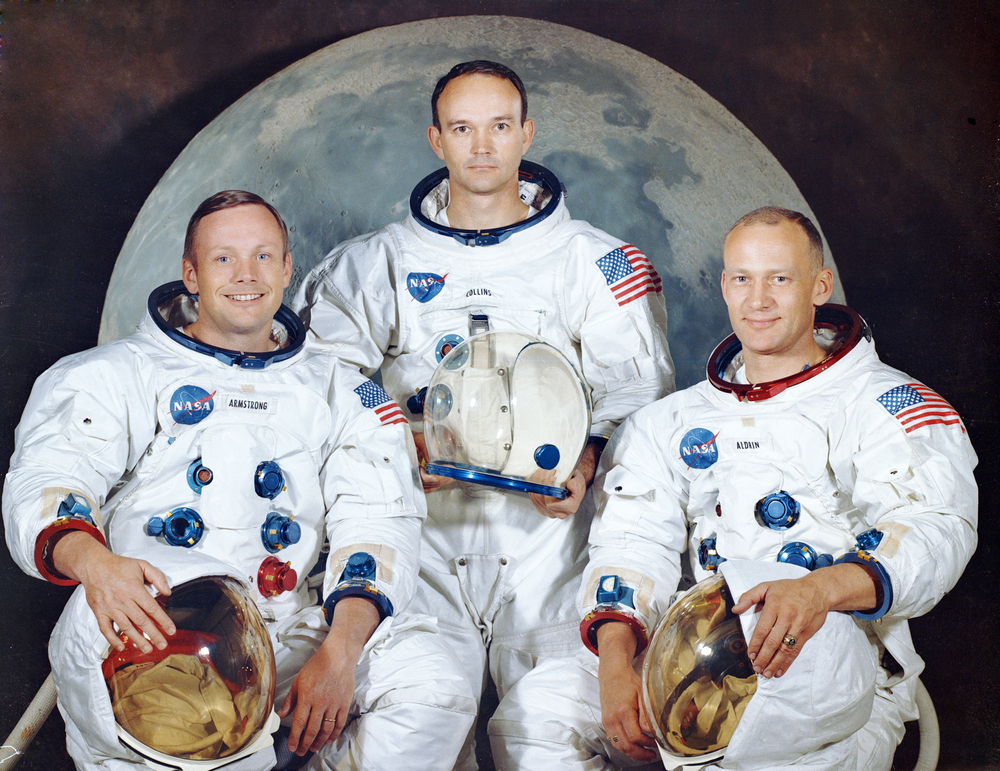
Apollo 11 was the first crewed mission to successfully land on the Moon, marking a historic milestone in space exploration. Launched on July 16, 1969, from Kennedy Space Center in Florida, it was the fifth crewed mission of NASA’s Apollo program. The spacecraft consisted of the Command Module (Columbia), piloted by Michael Collins, and the Lunar Module (Eagle), operated by Neil Armstrong and Edwin “Buzz” Aldrin. The mission’s primary goal was to perform a crewed lunar landing and return safely to Earth, fulfilling President John F. Kennedy’s ambitious challenge from 1961. Millions around the world followed the journey live through television and radio, turning the mission into a global event.
On July 20, 1969, the Lunar Module separated from Columbia and descended toward the Moon’s surface. The descent was tense — Armstrong had to manually pilot Eagle to avoid landing in a crater filled with boulders, leaving only about 30 seconds of fuel left when the craft touched down in the Sea of Tranquility. Upon landing, Armstrong radioed the famous words, “Houston, Tranquility Base here. The Eagle has landed.” Hours later, Armstrong became the first human to set foot on the Moon, describing the moment as “one small step for man, one giant leap for mankind.” Aldrin soon followed, and together they spent about two and a half hours exploring, taking photographs, collecting lunar rock and soil samples, and deploying scientific instruments.
Meanwhile, Collins remained in lunar orbit aboard Columbia, ensuring the Command Module was ready for their return. Though he never set foot on the Moon, his role was critical — without him, Armstrong and Aldrin would have had no way back to Earth. The mission also carried experiments such as a seismometer to study moonquakes and a laser reflector to measure the distance between Earth and the Moon. Their work contributed invaluable data for understanding the Moon’s environment and history.
Apollo 11 safely returned to Earth on July 24, 1969, splashing down in the Pacific Ocean where they were retrieved by the USS Hornet. The astronauts underwent quarantine to prevent any potential contamination, though no lunar pathogens were found. The mission not only achieved a major technological and scientific triumph but also became a symbol of human ingenuity and determination during the Cold War space race. Its success paved the way for future Apollo missions and cemented its place as one of humanity’s greatest achievements in exploration.